

Keywords: AI talent shortage UK, AI engineer jobs London, AI recruitment trends 2025, generative AI hiring, MLOps demand, AI salaries UK vs US, AI skills gap, global AI hiring, UK National AI Strategy, AI job market comparison
The Global Race for AI Talent
Artificial Intelligence is no longer a niche capability; it’s the backbone of innovation across every major sector. From autonomous systems and predictive analytics to generative AI and quantum computing, the demand for AI engineers has surged globally. And while the UK has made bold moves to position itself as a leader, the US continues to dominate in scale, investment, and hiring velocity.
UK vs US: A Tale of Two AI Markets
| Metric | United Kingdom | United States |
| Market Size (2025) | £72 billion | $73.98 billion |
| Top Hiring Cities | London, Cambridge, Manchester | San Francisco, New York, Austin |
| Average AI Engineer Salary | £120,000–£150,000 | $150,000–$300,000 |
| Government Strategy | UK National AI Strategy, AI Growth Zones | Federal AI R&D funding, CHIPS Act, AI Institutes |
| Talent Shortage | 70,000+ skilled roles unfilled | 650,000+ projected shortfall by 2027 |
| Hiring Velocity | Competitive but constrained by education pipeline | Aggressive, driven by VC and Big Tech |
The US benefits from massive venture capital flows and deep integration of AI into its startup ecosystem. In contrast, the UK boasts academic excellence and a strong fintech sector but faces structural challenges in scaling its AI workforce fast enough to meet demand.
Roles in High Demand
Keywords: generative AI engineer, MLOps specialist, AI product manager, AI governance lead, NLP developer, computer vision engineer
- Generative AI Engineers: Building and fine-tuning large language models (LLMs) for enterprise and consumer applications.
- MLOps Specialists: Ensuring scalable deployment and monitoring of AI systems.
- AI Product Managers: Translating technical capabilities into commercial outcomes.
- AI Governance Leads: Navigating ethical frameworks and regulatory compliance.
- NLP & Vision Engineers: Powering chatbots, autonomous vehicles, and medical imaging.
The UK’s Strategic Imperative
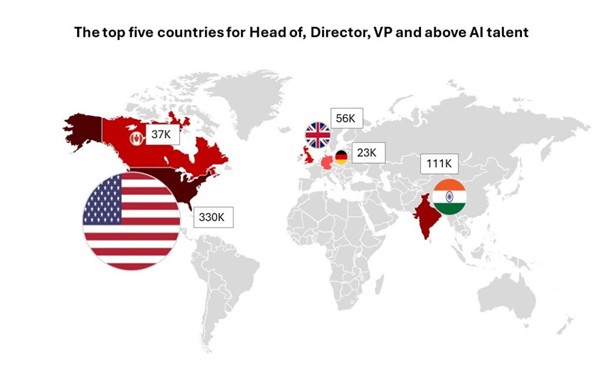
Despite ranking third globally for AI talent, the UK faces a widening skills gap. A recent survey found that 73% of UK professionals have had no formal AI training, and only 22% of AI roles are held by women. The government’s push to create 13,000 new tech jobs is ambitious, but without rapid upskilling and global hiring, it risks falling short.
Keywords: AI education UK, AI gender gap, AI training programmes, UK AI skills shortage
Global Hiring: A Necessary Solution
To bridge the gap, UK firms are increasingly hiring internationally:
- 43% of UK businesses are open to global hiring to fill AI roles
- Top sourcing markets include the US, Europe, and Canada
- Remote work and hybrid models have made cross-border recruitment more viable than ever
Keywords: global AI recruitment, remote AI jobs, international AI hiring, borderless tech talent
What Needs to Happen Next
To remain competitive, the UK must:
- Accelerate AI education and apprenticeships
- Create visa pathways for elite AI talent
- Fund regional AI hubs beyond London
- Support SMEs with access to AI tools and talent
Final Word
The AI talent war is not just about hiring, it’s about national resilience, economic growth, and technological sovereignty. Britain has the potential to lead, but it must act with urgency and precision. The future of AI will be shaped by those who build it, govern it, and deploy it responsibly.
Keywords: AI future UK, AI innovation strategy, AI workforce development, UK tech leadership